
Trump couldn't care less anymore about the Israeli demand for Iran's 'de-nuclearisation' and 'de-militarisation.' Trump pins hopes on a grand bargain with Iran as a partner in America First, argues Ambassador M K Bhadrakumar.

Israel's aerial assault on Iran is widely viewed as an act of naked aggression with no basis in international law, carried out unilaterally despite US opposition and aimed at derailing ongoing US-Iran nuclear negotiations, observes Ambassador M K Bhadrakumar.

Iranian Foreign Minister Abbas Araghchi visited Pakistan and called on both India and Pakistan to "exercise restraint" amid rising tensions between the two countries following the Pahalgam terror attack. Araghchi, who is scheduled to travel to India on Thursday, emphasized the importance of easing tensions and preventing further escalation. During his talks with Pakistani officials, Araghchi and Pakistani Foreign Minister Bilawal Bhutto Zardari reaffirmed their commitment to strong Pakistan-Iran ties and agreed to boost cooperation in trade, energy, and connectivity. Both sides also exchanged views on the situation in South Asia and the US-Iran talks, while agreeing that complex regional issues could be resolved through diplomacy and negotiations.
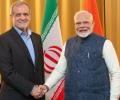
'Within minutes, my mobile began ringing. It was National Security Adviser Brajesh Mishra, asking why the Iranians were complaining.' 'I explained that we had only restated our position in the light of the conclusion reached by the IAEA, but will remain helpful to Iran to reach a consensus.' 'Then came a call from Foreign Secretary Kamal Sibal, repeating what Mishra said about the Iranian complaint.' 'I was very impressed that Iran was able to reach two top officials in India to intervene at short notice,' recalls Ambassador T P Sreenivasan.
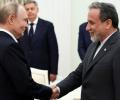
Will Russia's entry deter Trump on his warpath?, asks Ambassador M K Bhadrakumar.
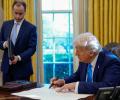
The stage may be set for a recalibrated US-Iran relationship, suggests Ambassador M K Bhadrakumar.
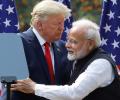
'Trump will absolutely back New Delhi on its position that Pakistan must do more to crack down on terrorists that threaten India.'

India's involvement in the port development was not strictly under the international sanctions that had been imposed on Iran.

'This incident offers ammunition to those inside the US government and elsewhere who question the wisdom of trusting India, so it will have a lasting consequence no matter how it is managed.'

'While the US-Pakistan relationship has been stabilised, it's still mired in uncertainty.'
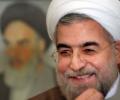
In a major diplomatic breakthrough, the foreign ministers of United States and Iran will hold talks on Tehran's controversial nuclear drive at a landmark meeting on Thursday -- the first between the two states in more than 30 years.

In a rare move that might end the chronic impasse between arch-enemies the United States and Iran, President Barack Obama could meet his Iranian counterpart Hassan Rouhani on the sidelines of the United Nations General Assembly.

The ballistic missile launch was the first by Iran since Trump became President.

In a move that may thaw the 34-year-old icy relationship between the United States and Iran, US President Barack Obama on Friday called his Iranian counterpart Hassan Rouhani and "exchanged pleasantries" in a 15-minute conversation.

The implications of the interim deal between Iran and the world's big powers go far beyond the nuclear programme, says Nitin Pai

You may be popular initially because of politics and ideology but if the economy slows down, you will be losing your popularity: Nouriel Roubini.

The perfunctory management of external affairs has left India's foreign policy establishment largely unprepared to manage the consequences of dramatic international developments, says Nitin Pai.

India on Wednesday termed as unjustified the American decision to impose sanctions on its two firms for supplying some chemicals to Iran, asserting that the transfer did not violate Indian regulations or its international obligations.

The reversal of Trump's policy with regard to Iran, like the withdrawal from the Paris Agreement, may not be a matter of just turning the clock back, but one of patient negotiations, with uncertain consequences in the post-COVID-19 world, observes Ambassador T P Sreenivasan.
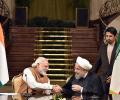
Iranian Ambassador to India Ali Chegeni said his country is 'not for war'. "We are looking for peace and prosperity for everybody in this region," he said.

"We have many relationships...they have a history. We will do what is in our national interest and part of that strategic partnership is the ability of each country to comprehend and appreciate the national interest of the other," Jaishankar said.

The United States has lifted most of its sanctions against Iran after a UN watchdog reported that Tehran had complied with a nuclear weapons deal.

We are much better placed than in 2013 with our overall fundamentals much stronger - higher foreign exchange reserves, a more favourable growth-inflation mix and an institutional framework for targeting inflation, says B Prasanna.
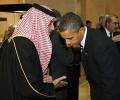
Further deterioration of the US-Saudi relationship will have geo-economic and geopolitical effects, says Nitin Pai.

Iran signed a $3 billion deal with Boeing, backed Qatar against the Saudis, scored a big victory in Syria and reached out to Hamas. Ambassador M K Bhadrakumar examines how the Qatar versus Saudi Arabia standoff is quickly changing alignments in the Middle East.

The Saudi-Pakistan nuclear weapons cooperation is meant to sound alarm bells in Washington, reminding the Obama administration that its overtures to Iran would have serious negative consequences in terms of its ties with its closest allies in the region, says Ambassador Talmiz Ahmad. Exclusive to Rediff.com
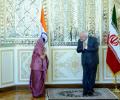
India's low passion, very cautious, relationship with Iran of the last 36 years awaits transformation, says Lieutenant General Syed Ata Hasnain (retd). Prime Minister Modi's visit cannot be a negotiating event; it is a symbolic one to strengthen the politico-diplomatic relationship.

He was ready even to take on Germany's collective guilt over the Holocaust
